
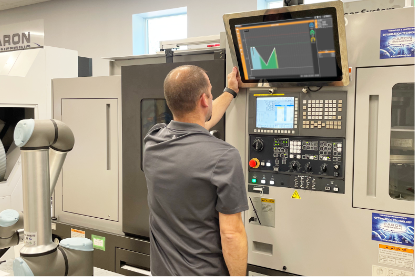









Think Your Shop Is Too Small for Automation? Think Again.
For many manufacturers, automation feels like something reserved for large production facilities with million-dollar budgets and lights-out machining cells.
If you're a small or mid-sized manufacturer, it's easy to assume that automation is simply out of reach.
But that's one of the biggest misconceptions in manufacturing.
The reality is that automation isn't defined by robots or fully automated production lines. It's about eliminating repetitive tasks, improving process consistency, and using technology to make better decisions automatically.
In fact, many of the highest-return automation projects begin with a single machine and solve a single production problem.

Automation Isn't All or Nothing
When people hear the word automation, they often picture robotic part loading or complex manufacturing cells. Those technologies certainly have their place—but they're only one piece of the automation puzzle. Some of the most impactful automation projects don't involve robots at all.
Instead, manufacturers begin by improving the machining process itself.
Examples include:
- Detecting tool wear before a tool fails
- Automatically adjusting feed rates as cutting conditions change
- Applying tool offsets from measurement data without manual entry
- Connecting machines to automation equipment and manufacturing software
- Guiding operators through standardized workflows
These improvements often require far less investment than manufacturers expect while delivering measurable gains in productivity and quality.

Start with Your Biggest Production Challenge
Rather than asking,
"How do we automate our shop?"
A better question is:
"What's slowing our shop down?"
Perhaps it's:
- Unexpected tool failures
- Scrap caused by dimensional variation
- Manual offset entry
- Operators spending time entering data
- Machines that don't communicate with other equipment

Solving one of these challenges is often the first step toward a more connected and automated manufacturing process.
Build Automation One Step at a Time
The most successful automation strategies are rarely implemented all at once. Instead, manufacturers build capabilities gradually. They may begin with tool monitoring to improve process stability. Later, they add adaptive control to optimize cutting performance. Measurement systems become connected to automatically compensate for tool wear. Machine data begins flowing between equipment and supervisory software. Operator workflows become standardized.
Over time, these individual improvements evolve into a connected manufacturing environment—without requiring a complete transformation on day one.
Technology Should Adapt to Your Shop
One of the biggest concerns manufacturers have is whether automation will work with their existing equipment.
Fortunately, modern manufacturing technologies are increasingly designed to integrate with both new and legacy CNC machines.
Real-time tool monitoring, adaptive control, machine connectivity, automated dimensional compensation, and operator authorization can often be implemented independently or combined over time as production needs evolve.
Rather than replacing equipment, manufacturers can build upon the machines and processes they already trust.

Small Improvements Create Significant Results
Automation isn't measured by the number of robots on your shop floor.
It's measured by improvements in productivity, consistency, and confidence.
For many manufacturers, the first automation project delivers benefits such as:
- Reduced scrap and rework
- Longer tool life
- Shorter cycle times
- Less operator intervention
- Improved process consistency
- Better production visibility
These gains often provide the foundation—and the confidence—to expand automation further.
Building a Practical Automation Strategy
At Caron Engineering, we've found that the most successful automation projects don't begin with the biggest investment—they begin with the right opportunity.
Whether that's monitoring cutting conditions, connecting machines, automating dimensional compensation, or improving operator workflows, each improvement builds toward a smarter manufacturing environment.
Automation doesn't have to happen all at once. It simply needs to solve the next problem worth solving.
Ready to Get Started?
If you’re considering automation but aren’t sure where to start, begin with the task or process causing the most trouble—whether that’s tool failures, manual offset entry, inconsistent results, or disconnected equipment.
Connect with the team at Caron Engineering to discuss your shop’s challenges. We’ll help you identify a practical first step using the machines you already have.


