












5 Hidden CNC Machining Inefficiencies That Could Be Costing You More Than You Think
As manufacturers plan for 2027, improving productivity and controlling costs remain important priorities. But before investing in additional equipment or expanding capacity, there's another question worth asking:
How much productivity are you losing from the CNC machines you already own?
A machine can be running, producing acceptable parts, and meeting its scheduled output while still operating below its potential.
Unnecessary cycle time, premature tool changes, minor process interruptions, manual adjustments, and disconnected production information can create hidden costs that accumulate across shifts and production runs.
Individually, these inefficiencies may seem insignificant. Collectively, they can represent substantial lost capacity, wasted resources, and missed opportunities. The challenge is recognizing where these losses occur and determining which improvements will deliver the greatest return.

Here are five common CNC machining inefficiencies worth evaluating as you plan for a more productive year ahead.
1. Unexpected Tool Failures and Unplanned Downtime
An unexpected cutting tool failure costs more than the replacement tool. Depending on the operation, it can result in damaged workpieces, interrupted production, additional inspection, machine recovery time, and potentially scrapped parts. In unattended machining environments, the consequences can be even greater if a failure goes undetected and production continues.
The hidden cost: Lost machine availability, recovery labor, damaged material, and potentially compromised downstream production.
What to measure: Tool failure frequency, average recovery time, scrap associated with failures, and the number of suspect parts requiring inspection.
Real-time monitoring of cutting conditions can help manufacturers detect abnormal loads, tool wear, and breakage as they occur, allowing the machine to respond before problems escalate.
Real-World Example: Detecting a Material Defect Before It Becomes a Bigger Problem
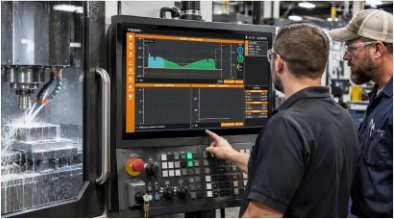
During a machining operation involving 2.5-inch 4140 steel bar stock, an unexpected material void created an abnormal cutting condition.
Caron Engineering's TMAC tool monitoring system detected the undercut condition and triggered an alarm, stopping the process and allowing affected parts to be isolated.
Without process monitoring, this type of material defect could go unnoticed until a later operation or inspection, potentially creating additional costs.
The value wasn't simply detecting an unusual condition. It was identifying the problem while corrective action could still limit its impact.

2. Cycle Time That Adds Up Across Production
Not every inefficient process looks inefficient. A CNC program may run reliably for years, but conservative feed rates, varying cutting engagement, or unnecessary non-cutting time can leave significant productivity untapped.
Consider a simple example.

At an illustrative machine-hour value of $100, that represents approximately $556 in recovered machine capacity per 1,000 parts. Across 10,000 parts, the same improvement represents approximately 55.6 hours of capacity.
This is an illustration of capacity value, not necessarily cash savings. The financial benefit depends on whether the recovered time can be used for additional production, overtime reduction, or other measurable gains.
The hidden cost: Production capacity lost through small, repeated inefficiencies.
What to measure: Actual cycle time, cutting versus non-cutting time, spindle load variation, and cycle time consistency.
Analyzing real machining conditions can reveal opportunities to optimize cutting performance. Technologies such as adaptive control can adjust feed rates within defined limits as cutting loads change, helping manufacturers make more effective use of available machine time. The goal isn't simply to run faster. It's to produce more efficiently while maintaining process stability and part quality.
3. Scrap and Rework That Could Be Prevented
Scrap is a visible expense, but the process conditions that create it aren't always addressed. Tool wear, dimensional drift, incorrect offsets, and delayed measurement feedback can contribute to parts falling outside tolerance.
In some operations, the problem isn't discovered until multiple parts have already been produced.
The hidden cost: Wasted material, additional machining time, inspection labor, rework, and delayed production.
What to measure: First-pass yield, scrap rate by operation, frequency of offset adjustments, and the number of parts produced between measurements.
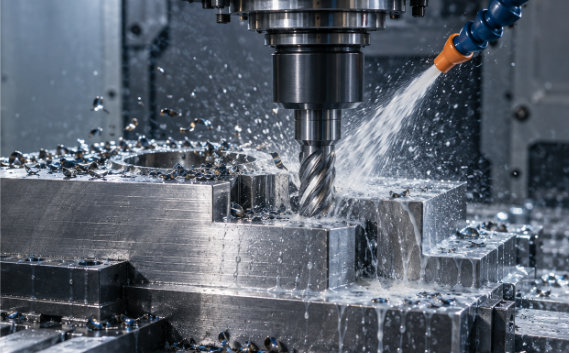
A valuable question is whether measurement information is being used only to inspect completed parts or also to improve the machining process. Connecting measurement results directly to CNC tool offset adjustments can reduce manual intervention and help maintain dimensional consistency. The opportunity is to move from detecting dimensional problems after production to correcting process variation as it develops.
4. Manual Tasks That Quietly Consume Productive Time
Not all manufacturing inefficiencies happen during machining.
Manual tool data entry, offset adjustments, transferring measurement results, and coordinating equipment can consume operator time throughout the day.
These tasks are often accepted as necessary parts of production because each one takes only a few minutes.
But repeated across machines, shifts, and changeovers, those minutes add up.
The hidden cost: Lost operator capacity, inconsistent workflows, setup delays, and preventable data-entry errors.
What to measure: Time spent on repetitive tasks, frequency of manual corrections, setup duration, and errors associated with information transfer.
Look for activities that require operators to repeatedly move information between systems.
For example, transferring tool measurements from a presetter to a CNC control, manually entering dimensional corrections, or coordinating equipment through separate interfaces may offer opportunities for automation.
Many of these processes can be improved independently without implementing a fully automated production cell.
The objective is to eliminate unnecessary manual steps with systems that transfer data automatically, allowing skilled operators to focus on higher-value work.

5. Manufacturing Data That Doesn't Drive Decisions
Modern CNC machines and manufacturing systems generate valuable information, including machine status, alarms, cycle times, cutting conditions, and measurement results.
But access to data doesn't automatically translate into better performance.
When information remains isolated across machines, devices, and software platforms, manufacturers may struggle to understand why problems occur or how frequently they repeat.
The hidden cost: Delayed troubleshooting, recurring production problems, and missed opportunities for process improvement.
What to measure: Time required to identify production issues, recurring alarm frequency, downtime causes, and how quickly corrective actions are taken.
The key is determining whether the information being collected helps someone make a decision—or enables a system to take appropriate action.
Connecting machine and process information can help manufacturers recognize patterns, identify recurring losses, and respond more consistently to production conditions.
The goal isn't more manufacturing data. It's better decisions based on the data you already have.
Where Are Your Biggest Opportunities for Improvement?
Not every inefficiency requires a major investment, and not every problem should be addressed at once.
A useful starting point is to connect common production challenges with measurable performance indicators.

This approach shifts the conversation from: What technology should we invest in? To: What production problem should we solve?
How to Prioritize Manufacturing Improvements for 2027
Choose an issue that occurs frequently, creates significant cost, or limits production capacity. A recurring tool failure on a critical machine may deserve attention before a smaller inefficiency spread across less important operations.
Start with a Measurable Problem
Choose an issue that occurs frequently, creates significant cost, or limits production capacity. A recurring tool failure on a critical machine may deserve attention before a smaller inefficiency spread across less important operations.
Establish Your Baseline
Document current performance before implementing changes. Whether you're measuring downtime, scrap, cycle time, or operator intervention, reliable baseline data is essential for evaluating results.
Calculate the Potential Impact
Estimate what an improvement could mean in recovered machine hours, reduced scrap, tooling expenses, or operator time. Be careful to distinguish theoretical capacity gains from actual financial savings. A reduction in cycle time creates value when that recovered capacity can be put to productive use.
Implement, Measure, and Expand
Start with a manageable improvement, evaluate the results, and determine whether the approach can be applied to additional machines or processes. A successful project doesn't have to transform an entire facility. It needs to solve a meaningful problem and provide a foundation for future improvements.
Ready to Get Started?
Discover how Caron Engineering's process monitoring, adaptive control, automated compensation, and machine connectivity solutions can help improve CNC machining efficiency. Contact our team to learn more or schedule a demo.