








How to Seamlessly Transition to Automated Processes in Legacy Manufacturing Systems
For many manufacturers, automation feels like an all-or-nothing proposition. If you’re running older CNC machines, legacy controls, or long-established manual processes, the idea of “going automated” can seem overwhelming—or worse, risky.
But here’s the truth: you don’t need to replace your machines to modernize them. Automation doesn’t have to be disruptive, expensive, or complicated. The key is knowing how to integrate automation gradually and strategically into your existing systems—and doing it in a way that brings immediate benefits.
At Caron Engineering, we work with manufacturers every day who face this exact challenge. Whether they’re running reliable but aging machines or dealing with isolated automation cells, they all ask the same thing: How do we make this work together without starting over?
The Real Challenge of Legacy Systems
Legacy manufacturing systems weren't built with today's automation in mind. Machines with different controls, manual data entry, and disconnected workflows are still common. While these machines can continue producing parts, they create challenges:
-
No visibility into real-time cutting conditions
-
Tools running until failure instead of to optional wear limits
-
Operators forced to run conservatively to avoid breakage
-
Higher scrap rates
-
Limited connectivity for data collection or supervisory reporting
The bigger risk is doing nothing- sticking with outdated processes while competitors embrace automation, increase throughput, and lower costs.
So, how do you modernize legacy systems without turning your shop upside down?

TMAC: Cutting Optimization and Real-Time Tool Monitoring for any CNC
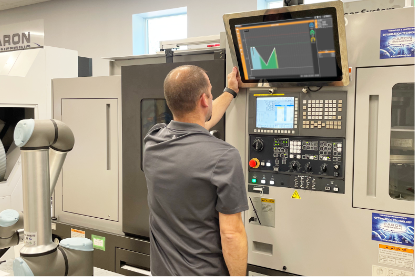
One of the fastest, most impactful steps is adding TMAC (Tool Monitoring Adaptive Control) to your legacy machines. TMAC continuously measures spindle motor power during every cut, analyzing the load profile in real time. With this information, TMAC can:
- Optimize cutting performance by automatically adjusting feed rates to maintain efficient, stable cutting.
- Detect tool wear by tracking changes in spindle load, allowing predictable replacement before failure. By capturing this data digitally, TMAC gives manufacturers a far more accurate picture of actual tool life – enabling tools to be used closer to their true limits instead of being swapped out prematurely.
- Catch tool breakage instantly by recognizing abnormal load spikes and stopping the machine to prevent part or spindle damage.

This combination of adaptive control and monitoring transforms even decades-old CNCs into smart machining centers. Instead of relying on conservative programs, TMAC enables machines to react to real-world conditions on the fly- extracting maximum performance while extending tool life, protecting the machine and tooling, and ensuring consistent part quality. And because TMAC integrates directly with most CNCs regardless of age or control type, it delivers automation benefits without expensive retrofits or replacements.
MiConnect: Turning Legacy Signals into Actionable Data

While TMAC enhances and protects cutting at the spindle, MiConnect extends automation visibility and control across the shop floor- especially for legacy equipment.
MiConnect can read I/O signals directly from older CNCs and peripheral devices, capturing critical status information such as machine cycle state, alarm conditions, or automation handshakes. These signals can then be combined with data from TMAC or other devices into one configurable workflow.
Beyond monitoring, MiConnect also has the ability to control machine functions by writing outputs back to the machine’s I/O. This makes it possible to add automation steps- such as triggering peripheral equipment, signaling robots, or automating manual interventions- that were never part of the machine’s original design.
Finally, MiConnect pushes all of this information upward into supervisory and enterprise systems using its REST API interface. That means legacy machines can now feed tool monitoring events, machine status. and automation signals directly into MES, SCADA, ERP, or cloud platforms-bridging the gap between the shop floor and enterprise-level visibility.
Real Impact, Real Fast
Modernizing legacy machines isn’t about “catching up”—it’s about making what you already have work smarter. With TMAC, you gain real-time tool wear and breakage detection, cutting optimization accurate digital tool life monitoring. With MiConnect, you not only expose hidden machine signals but also gain the ability to control machine functions and integrate data into supervisory systems.
And with AutoComp, you take the final step: automating dimensional control. AutoComp ingests measurement data from electronic gauges, CMMs, scanning systems, vision devices, or even digital calipers, compares the results against tolerance limits, and writes the required tool offset adjustments directly into the CNC. No manual data entry, no operator judgment—just fast, accurate corrections applied in real time.
Together, TMAC, MiConnect, and AutoComp create a fully connected and optimized manufacturing environment—built around the machines you already own, without costly retrofits or complete system overhauls.

Ready to Get Started?
If you’re ready to bring adaptive control, data-interchange, or closed-loop feedback to your legacy machines—or want to design a phased automation strategy tailored to your shop—reach out to our team at caroneng.com.


